Curved Shapes and Arches in Interiors – How to Seamlessly Finish Rounded Walls?
Contemporary interior architecture is clearly moving away from sharp, austere angles in favor of organic forms. Rounded corners, geometric arches, and columns are solutions that give an interior a premium character, bringing visual balance and harmony to the space. While soft lines look incredibly aesthetic, their execution and perfect finishing often pose a significant challenge.
Traditional finishing materials are rigid, and attempting to adapt them to arches usually involves time-consuming plastering, sanding, and the risk of cracks. The key to success is using technologically advanced, flexible components that perfectly replicate curves, while ensuring durability and an impeccable appearance for years.
Fluid Architecture: Why Choose Curved Forms?
Introducing curves into residential or commercial spaces is a proven way to optically soften a room's proportions. Difficult areas, such as structural pillars or irregular recesses, can become a decorative focal point instead of an arrangement problem. However, for the final effect to impress with precision, plastic wall surfaces require dedicated 3D structured claddings that interact with light and mask any imperfections in the substrate.
Instead of standard wall solutions, it is worth choosing high-density materials in areas exposed to mechanical damage. This ensures long-term resistance and eliminates the need for frequent painting touch-ups or plastering.
Flexible Decorative Panels – A Revolution in Finishing Arches
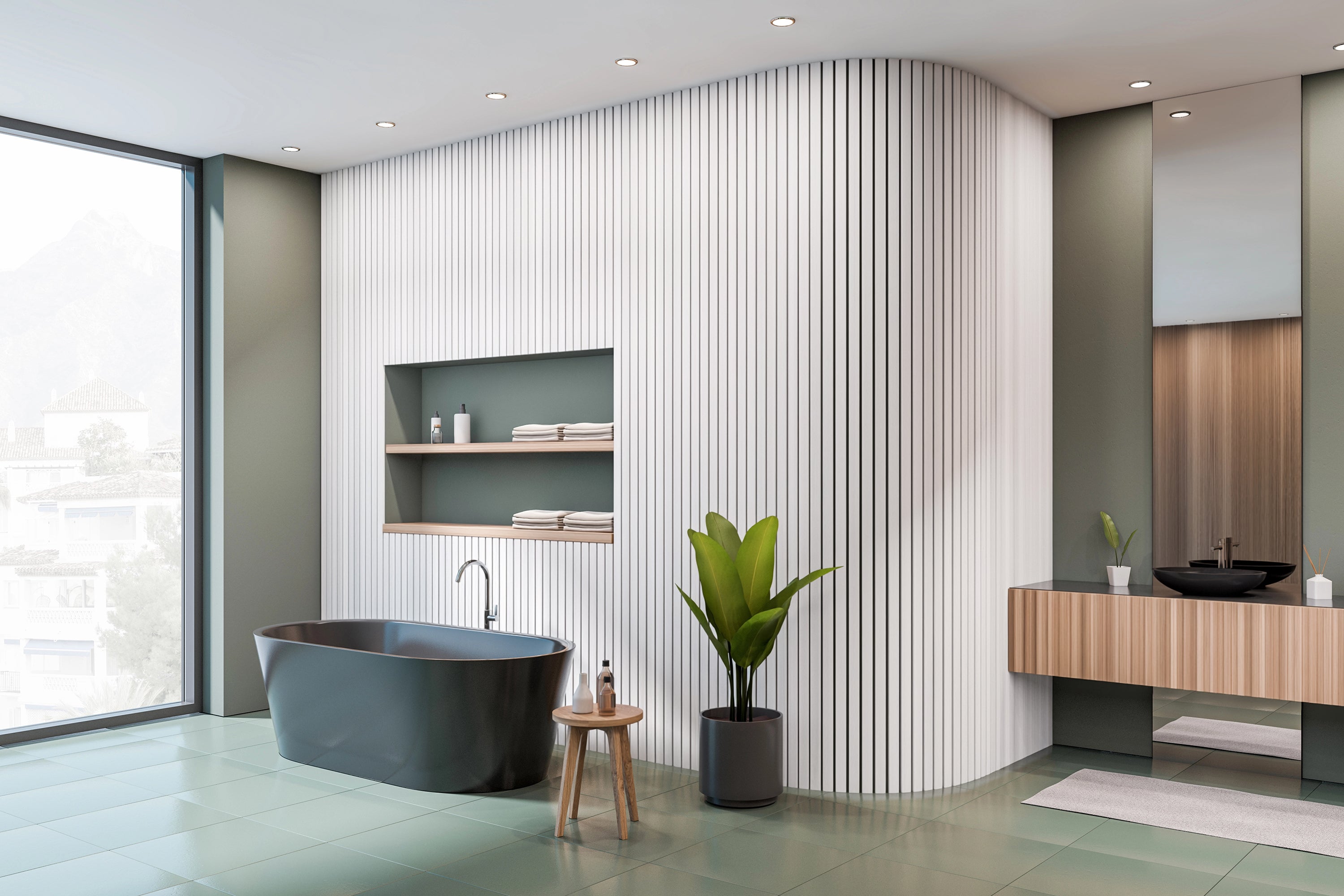
Traditional wall lamellas made of MDF or wood cannot be bent, making it technically impossible to finish a round pillar or a wavy wall with them. Modern flexible panels are the answer to these structural limitations. They allow for a smooth transition along a curve without visible joints and without the need for troublesome cutting of the material from below.
Recommended product:
THALIA FLEX Cezar wall panel
Material: High-density polystyrene (HDPS) – lightweight, hard, and dent-resistant.
Single panel dimensions: 14 mm (thickness) x 41 mm (width) x 2800 mm (length).
Surface finish: Matte varnish, factory-prepared for painting with water-based paints.
Properties: 100% waterproof, moisture-resistant, innovative CLICK-type connection.
Product link: THALIA FLEX Cezar wall panel
💡 Installation tip: Before installing panels on a heavily rounded surface, thoroughly clean and degrease the substrate. Use only dedicated mounting adhesives recommended for HDPS polystyrene. Cut the panels with a fine-toothed saw to ensure a perfectly smooth edge without chipping.
Water resistance and durability in demanding areas
Finishing arches in bathrooms, bathhouses, or home SPA zones brings additional requirements – the material must be completely impervious to direct water exposure. The use of high-density polystyrene eliminates the risk of swelling, rotting, or mold growth, which often occurs with wood derivatives. This allows for stylistic consistency based on curved shapes to be maintained in every room of the house.
In addition to the wall panels themselves, proper floor finishing is crucial for maintaining visual consistency. Transitions between panels and ceramic tiles on curved surfaces require flexible profiles. In dry areas, flexible Cezar skirting boards, which perfectly adhere to wall curves, masking expansion joints, will work excellently.
💡 Arrangement tip: To achieve a total look effect, after installing the flexible panels, paint them with the same paint you used on the smooth part of the wall. The matte base lacquer structure ensures excellent adhesion of paint coatings without prior priming.
How to Achieve a Cohesive Effect? Composition Checklist
✔ Color consistency – match the shade of the flexible finishing elements to the interior's color scheme, taking advantage of their paintability.
✔ Expansion joint protection – remember that the floor near a rounded wall also works; use flexible skirting boards whose radius matches the curve.
✔ Seamless connections – choose products with a CLICK system, which guarantees no visible, unsightly gaps at panel joints.
✔ Play of light – install LED lighting along the rounded 3D space to emphasize the depth of the structure and the plasticity of the form.
✔ Selection of appropriate adhesives – use binders with high initial adhesion that will immediately bond the flexible profile to the wall curve.
5 Golden Rules for Finishing Rounded Walls
Choose dedicated (Flex) materials: Never forcefully install rigid profiles on curves – material tension will cause it to detach or crack.
Opt for HDPS polystyrene instead of MDF: In areas with varying humidity and in high-traffic zones, use only hard, waterproof polymer plastics.
Pay attention to the joining system: Panels joined by sliding or pressing (CLICK type) ensure a uniform surface without the need for plastering contact points.
Paint after installation: Always do the final painting after gluing the panels – this will perfectly mask micro-installation gaps.
Match the cutting technique: Use tools with fine-tooth geometry to avoid melting or chipping the edge of the plastic when shortening panels to size.
FAQ – Frequently Asked Questions
Can flexible wall panels be used in the shower?
HDPS polystyrene panels are 100% waterproof and do not swell under moisture. They can be used in bathrooms, but in the direct spray zone, full substrate waterproofing must be ensured, and waterproof adhesive and polyurethane sealant must be used on the joints.
What paint should be used on THALIA FLEX panels to avoid damaging their surface?
The panels have a factory-applied matte coating suitable for painting with water-based paints (acrylic, latex, silicone) or paints designed specifically for plastics. Aggressive solvent-based paints should not be used.
How can wall imperfections on a curve be hidden with decorative panels?
The three-dimensional 3D structure of flexible panels perfectly masks minor curves, plaster defects, and wall flaws. This allows for installation without troublesome plastering, sanding, and dust generation.
What is the minimum bending radius for flexible polystyrene panels?
Thanks to their ultra-light and advanced design with a thickness of 14 mm and a single module width of 41 mm, the panels freely adapt to most standard columns, arches, and architectural recesses found in residential and commercial construction.
Are specialized tools needed to install panels on curves?
No, installation is quick and simple. It only requires a standard hand saw or miter saw with a fine-toothed blade for cutting to length (2800 mm) and a glue gun for mounting adhesive.
Summary
Introducing curved shapes and arches into an arrangement is synonymous with a modern approach to design that redefines the concept of luxury in interiors. The choice of advanced materials, such as flexible polystyrene panels, eliminates the most difficult stages of plastering work. By combining Flex technology with functionality, we gain not only spectacular visual order but also a durable and moisture-resistant wall surface that will retain its geometric perfection for years.
Share:
Modern bathroom – how to finish it with aluminum profiles and Cezar strips?
Kontrast i struktura we wnętrzu: Jak łączyć sztukaterię, panele 3D i czarne detale