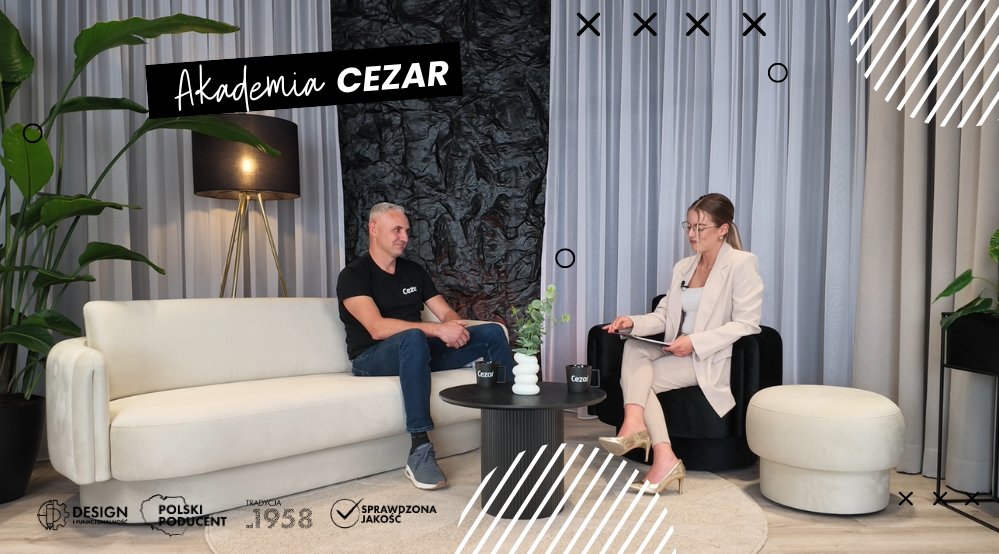
Have you ever wondered what goes on behind the closed doors of a modern factory before the finished product hits the store shelf? In the second episode of the Cezar Academy podcast, Kinga talks to Arek – a production manager who reveals the inner workings and secrets of our company. We invite you on a fascinating journey through the world of modern technologies and large-scale manufacturing.
You can watch the entire episode directly on our YouTube channel: Watch #2 The Heart of Our Production Revealed.
The enormous scale of Cezar's production
The figures our production department operates with can be mind-boggling. We're not talking about hundreds or thousands of units – these are millions, which best illustrate our position in the interior finishing market:
-
Over 12.9 million PVC skirting boards – that's how many our team produced in just one year. With an average length of 2.5 meters, this totals 32 million linear meters. This amount of material would be enough to encircle almost 80% of the Earth's circumference!
-
Over 7.1 million aluminum profiles – this is an impressive result from the metal department alone for 2025. The total length of these profiles is approximately 17,000 kilometers, which is equivalent to the distance from Poland to Australia.
-
3342 tons of PVC raw material used – this mass of polyvinyl chloride translates to approximately 140 fully loaded trucks.
Such a huge undertaking requires perfect infrastructure. Currently, Cezar comprises 10 modern factories located in 3 cities: Ełk, Białystok, and Suwałki.
How is a skirting board made? Step by step
To an outsider, a production hall might seem like a loud and chaotic place. However, in reality, every stage is planned with meticulous precision and runs like clockwork. The entire production process proceeds in several key phases:
1. Quality control and in-house mixing facility
It all begins when a tanker truck arrives at the factory with polyvinyl chloride or chalk. After rigorous inspection, the raw materials are sent to the mixing department. By mixing the raw materials ourselves, we are completely self-sufficient. This allows us to react instantly to market demand, for example, by creating a brand-new color at the customer's request.
2. Extrusion
The ready, precisely prepared mixture goes into advanced extruders, which give it its initial shape.
3. Calibration and cooling
The hot profile leaving the extruder passes through a special calibrator. Then it goes into a cooling bath filled with coolant, where it gains its final form and rigidity.
4. Cutting, packaging, and palletizing
The cooled profile is precisely cut to size, packaged, and then arranged on pallets. The prepared goods are then sent to the warehouse and are ready for shipment.
Guarantee of repeatability and automation
One of the biggest challenges in the finishing industry is ensuring perfect color and dimensional repeatability. Customers who choose professional skirting boards for panels and tiles several months apart expect an identical shade.
At Cezar, we ensure this with specialized measuring devices and physical samples. These devices continuously monitor gloss, shape, and color on the production line. If any anomalies are detected, operators act according to strictly defined procedures. If necessary, they quickly stop the machine and clean the tools to resume ideal production.
We also constantly invest in automation. Modern extruders operate on four streams simultaneously. To keep up with such a fast pace and relieve employees, we have introduced automatic labeling for each stream separately. Despite such advanced technology, Arek emphasizes one thing: the smartest machine is nothing without a skilled, committed person.
People are the heart of our company
Despite automation and robotization, people are the biggest driving force behind the Cezar brand. Arek manages a team of 110 employees and four deputies within five production departments. Production cooperates closely with quality control, technologists, and the maintenance department to ensure every product meets the highest standards.
Our company is constantly expanding, building new halls and installing modern machinery. That's why we are always looking for new talents to join our dynamic team. If you want to learn more about career and development opportunities within our structures, visit the join us tab. You don't have to be an expert right away – willingness is what matters most, and our experienced team will gladly introduce you to your daily duties.
Common mistakes – what to avoid when choosing skirting boards and profiles?
-
Ignoring room conditions – choosing classic MDF skirting boards for a bathroom or kitchen is a common mistake. In humid areas, fully waterproof PVC skirting boards are best.
-
Buying material "just enough" – when installing skirting boards and aluminum profiles, there are always losses when cutting corners. It is always recommended to purchase about a 10% surplus of material.
-
Ignoring expansion joint width – when masking expansion joints next to a wall, choose a skirting board of appropriate width. It must fully cover the gap without blocking the natural movement of the floor.
FAQ – Frequently Asked Questions
Where exactly are Cezar's factories located?
Our production is located in three cities in northeastern Poland: Ełk, Białystok, and Suwałki. In total, we have 10 modern factories there, which are constantly developing their machine park.
Is prior experience required to work in production at Cezar?
No, we do not require prior experience or expert knowledge. For new employees, the most important thing is a willingness to work, and our experienced specialists, who are happy to share their knowledge, will teach you everything you need. You can find all details and the application form in the join us section.
How does Cezar ensure the color consistency of its products?
We use precise physical samples and advanced measuring machines to control color, shape, and gloss on the production line. This ensures that subsequent batches of products maintain identical visual parameters.
Where can I find products perfectly suited for wall corner protection and tile finishing?
All specialized finishing profiles, including the extremely durable and precisely manufactured corner guards are available directly in our product catalog. They are a key element of aesthetic edge protection in any modern interior.
Share:
Idealne narożniki – jak przycinać listwy sufitowe bez błędów?
Koszt montażu paneli ściennych 3D – ile zaoszczędzisz, wybierając Thalia Flex? (Kalkulacja i podsumowanie)