Producing a perfectly white finishing element is one of the greatest technological challenges in the interior design industry. Although a white trim may seem like a universal and simple solution from the investor’s perspective, in production it mercilessly exposes every microscopic imperfection and deviation from the standard.
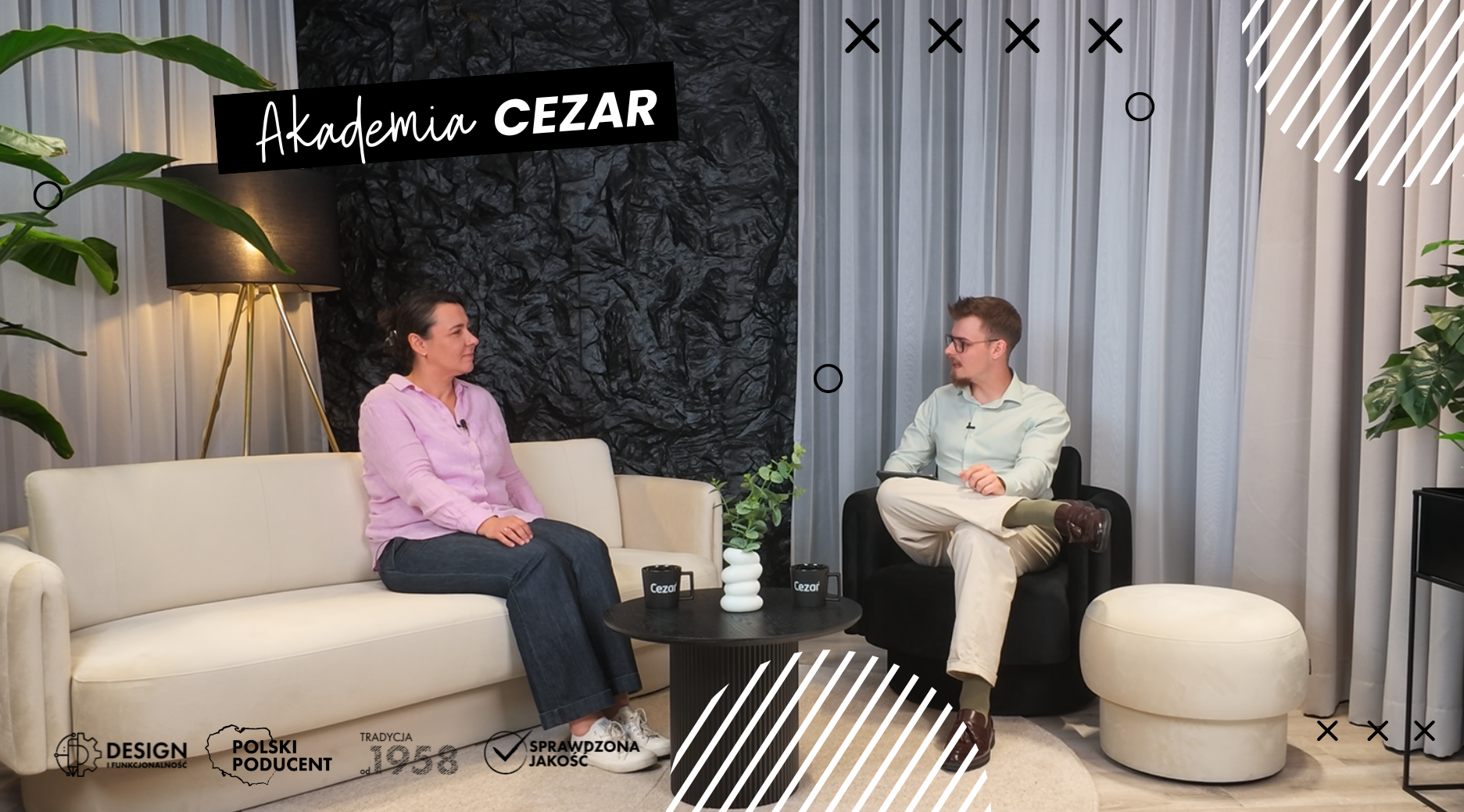
We talk to Ewa Litwinko, Head of Quality at Cezar, about the behind-the-scenes work of quality management, embedding procedures in production processes, and the challenges involved in striving for perfectly consistent products.
Modern quality management: Why is inspection after the fact a mistake?
Traditional quality control—understood as catching defective products at the very end of the production line—is now an outdated and uneconomical approach. Detecting a defect in the finished product means that raw materials, energy, and people’s working time have already been irretrievably lost.
The modern approach is based on the principle that quality must be built directly into the production process. To achieve this, Cezar reorganized its structure, dividing the Quality Department into two specialized areas:
-
Operational Quality: A team working directly on the production floor, supporting machine operators and responding to process issues as they arise.
-
Quality Management: The area responsible for developing procedures, analyzing nonconformities, overseeing reference samples, and working directly with suppliers and customers.
Thanks to lean management workshops and a clear division of responsibilities—from verifying raw materials in the technology laboratory to ongoing supervision of measuring instruments—any deviations are detected and eliminated immediately.
The challenge of white: Quality control from raw material to finished product
Why is a white product the most technologically challenging? White leaves no room for shortcomings. The slightest change in the raw material’s shade, a subtle change in processing temperature, or a deviation in the material’s structure can make two elements installed side by side look different.
Perfect consistency is crucial for the customer. Someone who buys white baseboards for the living room and decides a few months later to buy the same model for the bedroom must receive a product with an identical shade and finish.
To guarantee this consistency, we use advanced solutions during production:
-
Colorimeters: Advanced measuring devices that digitally measure the color of semi-finished and finished products, eliminating the margin of error associated with the human eye.
-
Custom 3D gauges: Modern inspection tools printed for the Quality Department, allowing operators to check the geometry and dimensions of trims immediately, without time-consuming manual measurements.
-
Strict raw material oversight: Verification of primary raw materials in the laboratory and ongoing checks of auxiliary materials by workstation managers.
DIY chain audits and a closed-loop material cycle
Cezar product quality is confirmed not only by internal procedures, but also by regular audits conducted by the largest international retail chains (including Leroy Merlin, Castorama, and OBI). These inspections verify that processes comply with stringent legal and performance standards. Audit scores of over 90% demonstrate the brand’s technological stability.
Even in the most advanced manufacturing plants, batches that do not meet specifications can occur. In such cases, the following procedure is crucial:
-
Immediate quarantine: A batch that fails to meet requirements is isolated inside the factory, completely eliminating the risk of defective goods reaching the market.
-
Recycling and regranulation: In the case of materials such as polystyrene, unused or defective material is processed into regranulate and reused in production.
-
Corrective actions: Every nonconformity is analyzed to identify its cause, enabling procedures to be continually improved and the risk of the same error recurring to be eliminated.
The most common mistakes when assessing the quality of finishing products
When assessing the quality of baseboards, investors and contractors often focus solely on appearance, overlooking key technical parameters. The most common mistakes include:
-
Buying products without checking batch consistency: Choosing random items from different production runs without any guarantee of color consistency.
-
Choosing a material unsuited to the surrounding conditions: Installing moisture-sensitive trims in rooms exposed to water.
-
Focusing solely on price: Overlooking dimensional stability and resistance to mechanical damage.
Summary: Quality assurance in practice
-
Prevention, not inspection: Quality is built during the design and execution of the process, not by rejecting defective finished products.
-
Advanced technology: The use of colorimeters and 3D gauges guarantees complete consistency in shades and shapes.
-
Strict external verification: Audits by international DIY chains, with scores above 90%, confirm the highest production standards.
-
Environmental responsibility: Recycling and regranulation systems allow raw materials to be safely reused in ongoing production.
Frequently asked questions (FAQ)
If I buy more trims after some time, will I get exactly the same color?
Yes. Thanks to digital color control using colorimeters and rigorous raw material standards, we ensure that products from different production batches have fully consistent shades.
What is the difference between quality control and quality management?
Quality control involves inspecting a product after it has been manufactured, which carries the risk of generating losses. Quality management prevents errors by properly designing the entire production process, training the team, and overseeing raw materials.
What happens to products that fail internal quality tests?
They are always quarantined inside the factory and never reach the point of sale. Most materials (e.g. polystyrene) are processed into regranulate and reused, reducing waste.
What standards do Cezar baseboards meet?
Our products meet stringent building and legal standards, as well as the demanding quality requirements of international retail chains, as confirmed by regular external audits that score above 90%.
Where can I find the full range of floor finishing products to suit my needs?
If you’re looking for durable, precision-made profiles suited to every type of flooring, explore our baseboards for laminate and tile. You can find additional resources and tips on our company blog, and if you have technical questions, please contact the Cezar team.


Share:
Thalia Flex – not just for wall curves
New Edition of the Cezar Quarterly: Product Innovation, Team Development, and Community Engagement