
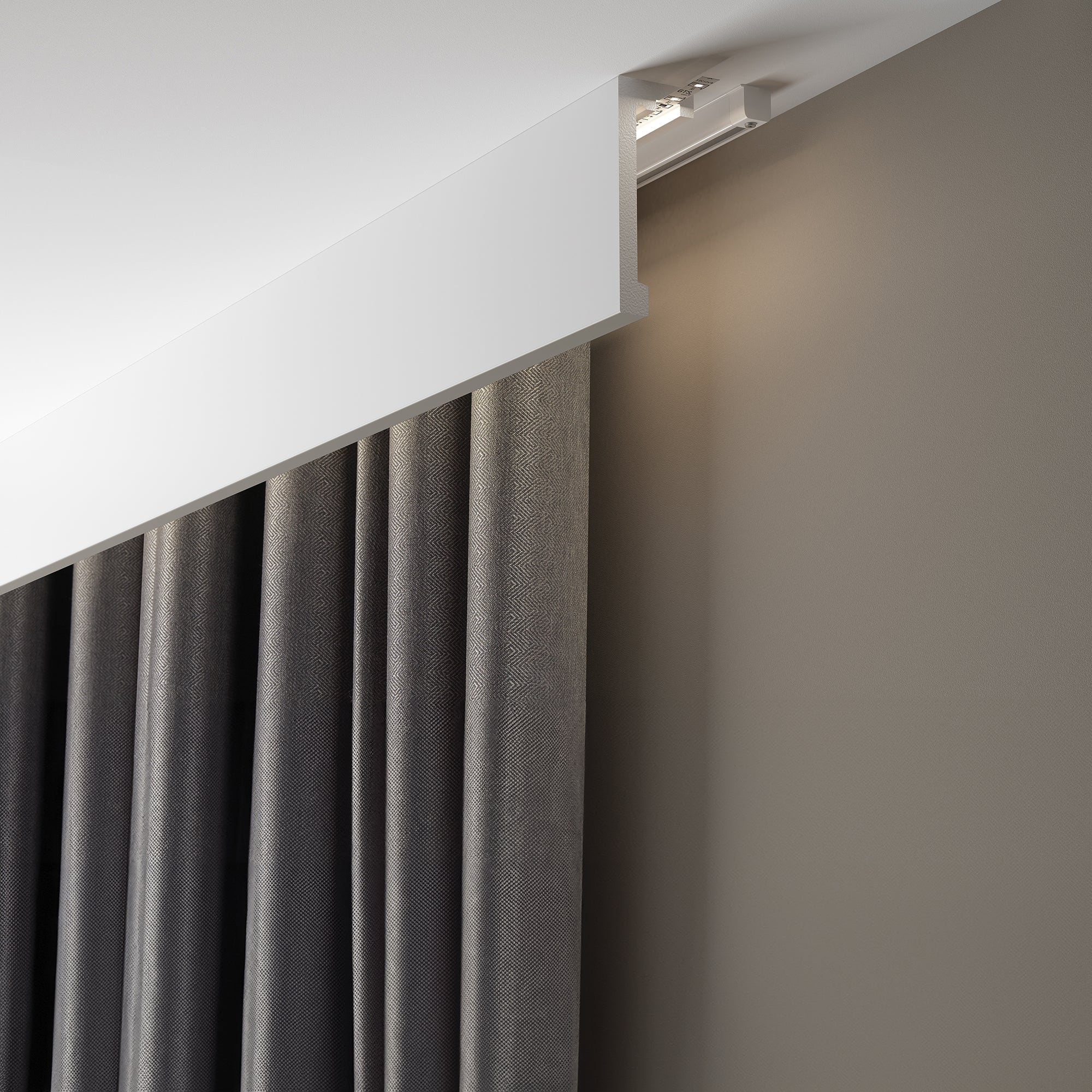
An aesthetic finish of the window area is a detail that determines the character of the entire interior. Traditional curtain rods or visible ceiling tracks do not always fit modern, minimalist arrangements. A solution that allows to maintain full harmony and purity of form is a curtain rod concealing strip. Thanks to it, all attention is focused on the decorative fabric, and the technical mounting elements remain completely invisible.
Why choose curtain rod strips?
Concealing mounting elements is just one of many advantages of this solution. Modern ceiling stucco serves both an aesthetic and a purely practical function.
Optical enlargement of the interior: A uniform ceiling line, smoothly transitioning into the masking strip, makes the room appear higher.
Integration with lighting: The special design of the profiles allows for internal installation of LED strips, creating a moody, diffused light in the interior.
Durability and lightness: The use of modern materials ensures that the profiles do not burden the ceiling, and at the same time are resistant to damage.
Which material works best?
The choice of the right profile depends on the technical specifications of the room and the desired visual effect. Polymer solutions dominate the market, outperforming traditional, crack-prone plaster.
Extruded polystyrene (XPS) strips
This is an extremely lightweight yet dimensionally stable material from which the line of ceiling curtain rod strips is produced. It is characterized by a smooth structure and factory coating with a special varnish. For example, the 100x40mm Cezar white RAL9003 satin curtain rod strip stands out with a noble, satin finish that perfectly matches the structure of modern ceiling paints. XPS profiles are completely moisture-resistant, so they can also be used in kitchens or bathrooms without any problems.
Installation of the concealing strip step by step
Installing the concealing strip does not require advanced construction skills, but precision and maintaining the correct sequence of actions are key to success.
Step 1: Selecting and mounting the hanging system
Before you proceed with gluing the stucco, appropriate curtain rod tracks must be mounted on the ceiling. It is important to maintain an appropriate distance from the window wall so that the curtains or drapes do not rest on the radiator or windowsill.
Step 2: Preparing the substrate and marking
The surface of the ceiling where the gluing will take place must be dry, dust-free, and degreased. Use a spirit level and a pencil to mark the line along which the outer edge of the concealing profile will run.
Step 3: Cutting the profiles to the correct length
For cutting XPS elements, it is best to use a miter saw with fine teeth or a hand saw with a miter box. This will allow for precise fitting of corners at a 45-degree angle.
Step 4: Gluing the concealing strip to the ceiling
Apply dedicated stucco adhesive (chemically neutral) to the upper mounting edge. Place the element on the ceiling along the marked line and press. Remove excess adhesive with a damp cloth.

Common mistakes when arranging the window area
Avoiding these few pitfalls guarantees that the final effect will be fully satisfactory and durable.
Too small a distance from the window: This results in an unsightly "folding" of the curtain material on the windowsill or radiator.
Using solvent-based adhesives: Aggressive chemicals can permanently damage or deform the structure of polystyrene (XPS).
Incorrect profile dimensions: A strip that is too low will not fully cover the frog or hook mechanism, which will ruin the desired visual effect.
Summary – installation checklist
[ ] Choose the right system and install curtain rod tracks taking into account the projection of the windowsill.
[ ] Select a profile of appropriate height (e.g., the dedicated 100x40mm Cezar white RAL9003 satin curtain rod strip).
[ ] Clean and prime the ceiling surface before adhesive application.
[ ] Use only dedicated solvent-free mounting adhesives.
[ ] Finish gaps at joints and corners with acrylic to achieve a uniform structure.
FAQ – Frequently Asked Questions
Can XPS concealing strips be painted?
Yes, most profiles can be painted with water-based paints (e.g., acrylic or latex) that do not contain solvents. In the case of factory-lacquered versions in matte or satin, painting is often not necessary.
How far from the track should the concealing strip be mounted?
It is recommended to maintain a distance of at least 2-3 cm from the edge of the track to allow free movement of frogs or hooks with the fabric and avoid rubbing the material against the profile.
Can LED lighting be installed inside the strip?
Yes, modern profiles have special recesses designed for gluing LED strips, which allows for a decorative backlighting effect for curtains.
Where can I find the complete system necessary for aesthetically concealing ceiling hooks?
All necessary elements, including concealing profiles and dedicated hanging systems, are offered by complete ceiling curtain rod strips, which guarantee full technical and visual consistency of the entire system.



Share:
White or floor-coloured trim – how to choose to match panels and doors
How to choose ceiling curtain tracks? A step-by-step guide