
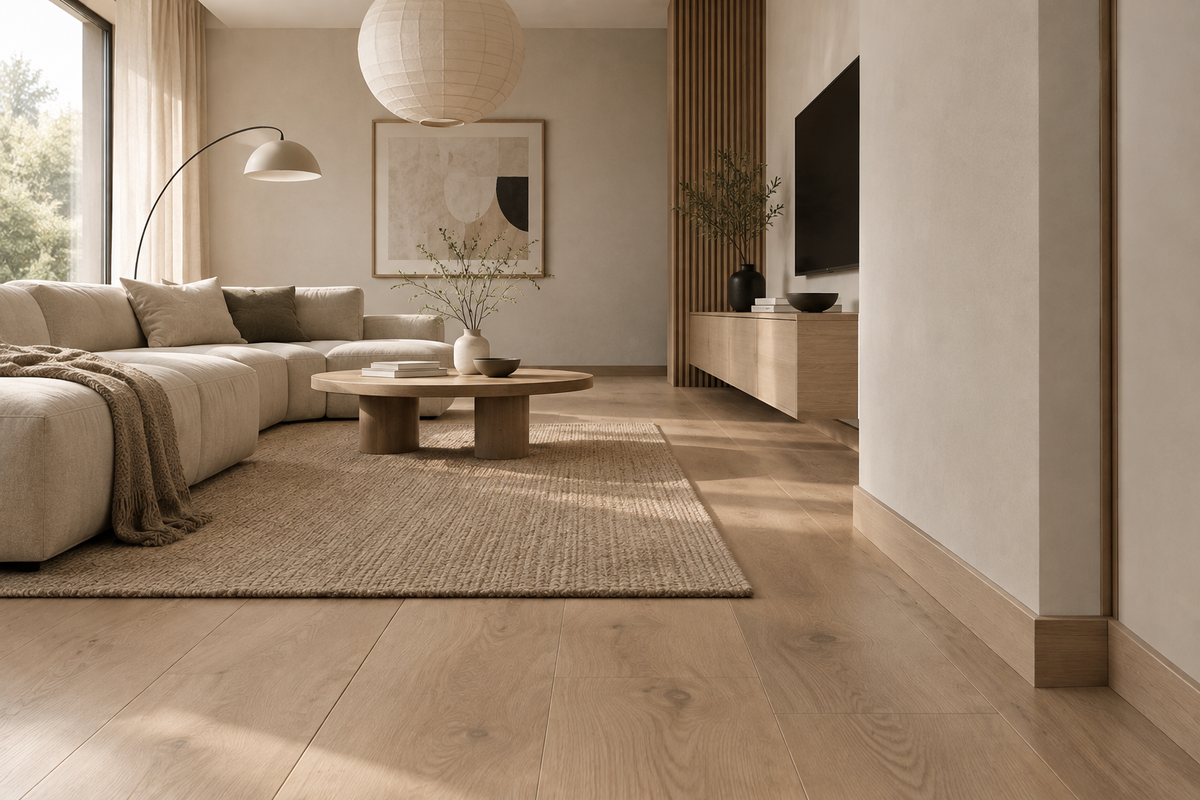
Japandi is one of the most balanced combinations in contemporary interior design. A fusion of Japanese minimalism with the functionality and warmth of Scandinavian hygge, it is based on clean lines, natural materials and a muted color palette. In such a restrained space, finishing details play a key role—any unsuitable element can disrupt the sense of harmony. The overall impression of an interior depends on choosing the right finishing elements, such as skirting boards, decorative profiles or discreet curtain installation. Find out how to use these components to create a cohesive, durable design.
1. Wall architecture – three-dimensional texture and chiaroscuro
Japandi-style walls are rarely smooth and white. They are defined by texture—slatted panels and wall panels with vertical grooves are a popular choice, adding soft interplay of light and shadow to the interior. They create rhythm and visually raise the ceiling while retaining a raw, elegant character.
Recommended product:
-
Name: PS Wall Panel Moulding THALIA04 155x14mm Creativa by Cezar L-2.80m White 101 L Matte Lacquer Primer
-
Materials and finish: Polystyrene (PS), matte finish (primed for painting or ready for direct use)
-
Dimensions: 155 mm (width) × 14 mm (thickness) × 2.80 m (length)
-
EAN code: 5902431281488
-
Link: PS Wall Panel Moulding THALIA04 155x14mm Creativa by Cezar L-2.80m White 101 L Matte Lacquer Primer
💡 Styling tip: You can paint the THALIA04 panel warm beige, sage green or off-white to match the wall perfectly. Its 2.80 m length allows for continuous installation from floor to ceiling without visible horizontal joints.
2. Discreet transitions and material divisions
Japandi dispenses with unnecessary ornamentation in favor of precise joints. The right finishing profiles allow you to neatly finish wall panels, protect the edges of boards or add subtle metallic accents that break up the matte surfaces of wood and plaster.
Recommended product:
-
Name: AL Aluminium Angle Profile 10x10x1mm L-2.50m Light Brushed Gold
-
Materials and finish: Aluminum (AL), light gold, brushed finish
-
Dimensions: 10 mm × 10 mm × 1 mm (wall thickness) × 2.50 m (length)
-
EAN code: 5902431057038
-
Link: AL Aluminium Angle Profile 10x10x1mm L-2.50m Light Brushed Gold
💡 Styling tip: Brushed aluminum in a light gold shade pairs beautifully with light wood (such as oak or ash). Use it as a slim border around wall panels or as a subtle edge profile where countertops meet wall cladding.
3. The foundation of the composition – simple, functional floor zoning
Clean lines at floor level are fundamental to a style inspired by Japan and Scandinavia. Traditional tall skirting boards with pronounced profiles are giving way to simple, matte skirting boards with a geometric cross-section. skirting board should visually connect the floor and the wall, conceal expansion gaps and protect the lower part of the wall from mechanical damage.
Recommended product:
-
Name: Skirting Board 80x14mm Cezar Neidin Matte 2.20m
-
Materials and finish: Highly durable finishing material, matte finish
-
Dimensions: 80 mm (height) × 14 mm (width) × 2.20 m (length)
-
EAN code: 5902431258671
💡 Installation tip: The matte finish of the Neidin skirting board prevents light reflections from floor-level spotlights or LED strips. Installation with construction adhesive eliminates the need for visible fasteners.
4. Intelligent light control – automating window treatments
In Japandi, light is treated as an integral element of the space. Window fabrics (linen, cotton) should fall freely from ceiling to floor. Smart home technology allows you to adjust light levels smoothly without visible, bulky mechanisms. electric curtain tracks are a perfect fit for the concept of invisible technology that supports everyday comfort.
Recommended product:
-
Name: Telescopic Electric Curtain Track 230V Wi-Fi with Remote Control Cezar White 2.50-4.50m
-
Materials and specifications: Telescopic system with integrated motor, Wi-Fi / RF remote control, 230V mains power, white
-
Adjustable length range: from 2.50 m to 4.50 m
-
EAN code: 5902431289132
-
Link: Telescopic Electric Curtain Track 230V Wi-Fi with Remote Control Cezar White 2.50-4.50m
💡 Installation tip: Thanks to its telescopic design, the curtain track does not need to be cut to size—the length can be adjusted on site. For the best aesthetic result, conceal the track in a dedicated ceiling recess or behind a decorative cover moulding.
How to achieve a cohesive look?
To preserve the desired sense of order and visual calm, follow these composition guidelines:
✔ Limit your material palette – choose no more than two shades of wood and one tone for metal accents (such as brushed gold).
✔ Use consistent surface finishes – combine matte or satin-finish elements; avoid high gloss.
✔ Pay attention to proportions – choose skirting board and panel heights to suit the room’s volume and ceiling height.
✔ Conceal the technology – install home automation mechanisms and wiring out of sight.
✔ Maintain continuous lines – align the edges of panels, profiles and window frames to create uninterrupted lines that guide the eye.
5 Golden Rules for Japandi-Style Interior Finishes
-
Quality over quantity – choose durable materials (high-density polystyrene, aluminum) that retain their shape for years.
-
Matte texture – choose matte and brushed finishes that diffuse light and give surfaces a subtle character.
-
Keep forms as simple as possible – opt for clean edges (90° angles or subtle chamfers) instead of profiled decorative mouldings.
-
Hidden functionality – integrate modern solutions (Wi-Fi controls, concealed tracks) without compromising the aesthetics.
-
Monochromatic color scheme – choose skirting boards and accessories in shades close to those of the walls or floor to create a seamless transition.
FAQ – Frequently Asked Questions
How does Japandi differ from classic Scandinavian style?
Japandi is more restrained, spatially disciplined and warmer in its use of materials. While Scandinavian style features plenty of white and light wood, Japandi incorporates elements of the Japanese wabi-sabi philosophy (appreciating imperfection), darker wood tones, ceramics, and black or brushed metal accents.
How do you choose the color of a skirting board for a Japandi interior?
A skirting board can be matched either to the wall color (which visually raises the ceiling and creates a uniform backdrop) or to the door frames. Matte finishes are recommended, as they blend harmoniously with plaster or paint.
Can a polystyrene (PS) wall panel be painted?
Yes. Panels made from high-quality polystyrene (such as Creativa THALIA04) come factory-primed. They can be painted in any color from your interior palette using water-based paints (acrylic, latex or silicone).
Does installing a telescopic electric curtain track require changes to the wiring?
The system only requires a standard 230V mains supply to be brought to the motor installation point. The length can be adjusted without cutting, within the range specified by the manufacturer (e.g. 2.50–4.50 m), and it can be operated wirelessly using a remote control or Wi-Fi app.
Which metal profiles work best with light wood?
Brushed-finish aluminum profiles in light gold, champagne or stainless steel shades pair best with light-colored woods (oak, ash, pine). A brushed finish creates a soft, elegant effect without overpowering the wood’s texture.
A well-designed Japandi interior is built on a balance between form and function. By choosing carefully considered trim systems, durable aluminum profiles and modern window automation, you can create a space free of clutter—beautiful, orderly and ready for comfortable everyday use.
Udostępnij:
How to Finish the Interior in Industrial and Loft Style?
Scandinavian style in a modern take. How to create a bright interior with class?