
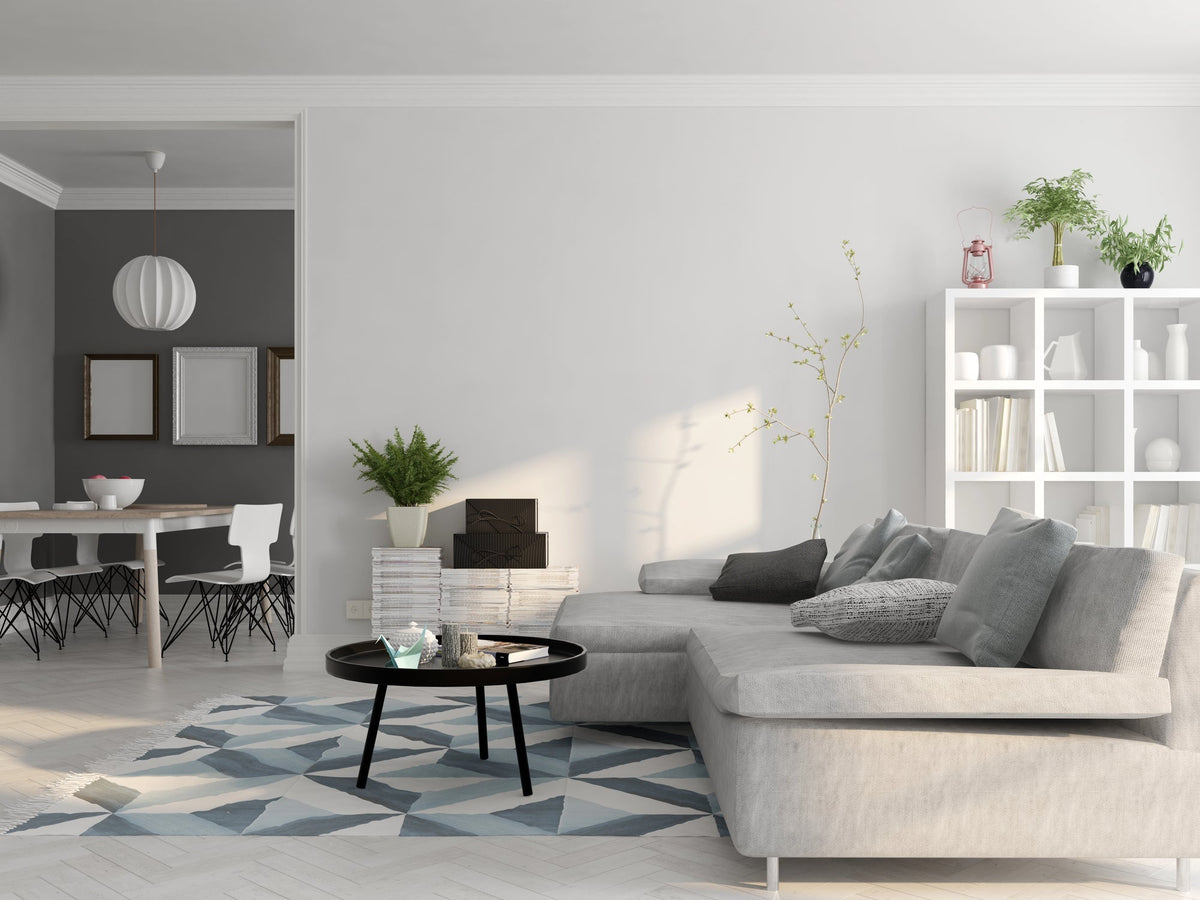
Scandinavian style has dominated interior design for years, combining functionality, simplicity and a connection with nature. The main aim of a design in this style is to make the space appear larger and make the most of natural daylight. A light colour palette, natural materials and minimalist forms create a cohesive, uncluttered backdrop. Contrary to appearances, Scandinavian minimalism does not mean austerity – the key to success lies in carefully selected finishing details, such as skirting boards and decorative mouldings, which complete the composition and give the interior a polished look.
Floor and wall – how to create a clean, attractive transition?
In Scandinavian design, the lower parts of a room play a key role in establishing its proportions. Light wood or laminate flooring needs a sturdy finish to separate it from the wall surface while also protecting the area around the floor from mechanical damage and dirt.
A tall skirting profile sharpens the floor’s lines and gives the room structure. Choosing white in line with the RAL colour standard ensures perfect harmony with the door joinery and light-coloured walls.
Recommended product: Decorative MDF Skirting Board 115x14.5 mm Cezar White RAL9003 Semi-Matt Foil 2.20 m
-
Material: High-density MDF
-
Finish: Semi-matt foil in White RAL9003
-
Dimensions: Height 115 mm, width 14.5 mm, length 2200 mm (2.20 m)
-
Catalogue number: 810459
-
EAN code: 5904584810459
💡 Installation tip: Install products made from high-density MDF using a dedicated mounting adhesive or clips. Factory-cut edges make it easier to achieve a perfect fit at the corners using a mitre saw.
Geometry and wall panelling – the lightness of wall mouldings
Scandi-style interiors avoid unnecessary decorative clutter. Instead of heavy paintings or bold patterns, designers often turn to wall mouldings, which add subtle light and shadow without weighing down the space.
Slim wall profiles can be used to create geometric frames, divide walls into functional zones or protect high-traffic areas from scuffs.
Recommended product: Smooth Wall Moulding LNG-29 Cezar Matt White 2.44 m
-
Material: Extruded polystyrene
-
Finish: Durable matt white finish
-
Dimensions: Height 30 mm, width 30 mm, length 2440 mm (2.44 m)
-
Catalogue number: 899065
-
EAN code: 5904584899065
💡 Installation tip: Mark the centre lines on the wall before attaching the profiles. After cutting them at a 45-degree angle, fill the joints with flexible joint adhesive. Once dry, sand them with fine-grit sandpaper and paint the resulting surface with wall paint.
A seamless transition from wall to ceiling – the role of cornice moulding
Finishing the area where the wall meets the ceiling can make a room appear taller and conceal any unevenness where the surfaces meet. Modern interpretations of Scandinavian style use finishing details that combine clean lines with subtle classical ornamentation.
Mouldings and wall decorations installed around the ceiling create an elegant finishing touch that brings all the joinery and decorative profiles together into a cohesive whole.
Recommended product: Decorative Cornice Moulding 02F Cezar White 101 Unfinished 2.40 m
-
Material: Plastic / finishing polymer
-
Finish: Unfinished surface ready for painting, White 101
-
Dimensions: Length 2400 mm (2.40 m)
-
Features: Decorative cornice profile
💡 Installation tip: Unfinished mouldings should be painted with the same paint used on the ceiling. This eliminates visual differences between materials and makes the mouldings look like an integral part of the building structure.
How can you achieve a cohesive look?
To keep a Scandinavian-style interior from looking chaotic, it is worth following a few basic principles of material and finish consistency.
✔ Keep whites consistent – make sure skirting profiles, doors and decorative elements have a similar colour temperature (e.g. pure white RAL9003). ✔ Maintain continuous lines – connect finishing profiles to the door frame without abrupt changes in thickness. ✔ Keep decorations restrained – add structure to the walls with the interplay of light and shadow created by mouldings, while limiting unnecessary furniture and ornaments. ✔ Choose a matt surface finish – avoid high gloss on large surfaces; matt and semi-matt finishes diffuse natural light more effectively.
5 Golden Rules
-
Choose a light backdrop: White, light grey and shades of beige provide the foundation for creating a bright space.
-
Choose durable materials: Use finishing profiles made from durable MDF, polystyrene or polymers that can withstand everyday use.
-
Keep elements in proportion: Match the height of skirting and wall mouldings to the size and height of the room.
-
Pair wood with simple forms: Soften the starkness of cool white with natural boards or panels featuring a pronounced grain.
-
Conceal installation flaws: Use wall and skirting profiles to hide wiring and expansion gaps.
FAQ
1. What colour skirting boards work best with Scandinavian style?
Classic matt or semi-matt white (e.g. RAL9003) is the best choice. It creates a cohesive transition with the door joinery and makes the floor appear larger.
2. Are MDF skirting boards resistant to mechanical damage?
Yes, provided you choose products made from high-density MDF and coated with a durable laminate or foil. They provide stability and resist scuffs in high-traffic areas.
3. Can polystyrene wall mouldings be painted?
Yes, most wall and cornice profiles can be painted with water-based paints (e.g. acrylic or latex) that do not contain solvents.
4. How do you join skirting boards at the corners?
The neatest finish is achieved by cutting the profiles at a 45-degree angle using a mitre saw with a fine-toothed blade or a mitre box, then joining them with mounting adhesive.
5. How does Scandinavian style differ from loft style?
Scandinavian style is based on light colours, the warmth of natural wood and simplicity, while loft style focuses on raw concrete, brick, black metal and an industrial finish.
Summary
Designing a Scandinavian-style interior calls for consistency in your choice of materials and careful attention to the quality of details. Well-chosen skirting, wall and cornice profiles organise the space, give it architectural structure and emphasise the natural character of a light-filled room. By choosing reliable finishing solutions, you can count on lasting durability and a timeless interior for years to come.
Share:
Discreet Japandi-Style Luxury – How to Choose Skirting Boards, Profiles, and Finishing Details?
English Wainscoting – How to Create an Elegant Interior?