⏱️ Reading time: 3 min
Modern interior design requires a combination of unique aesthetics, high mechanical resistance, and an eco-friendly approach to production. A key role in this dynamically developing industry is played by HDPS (High Density Polystyrene), a high-density polystyrene material.
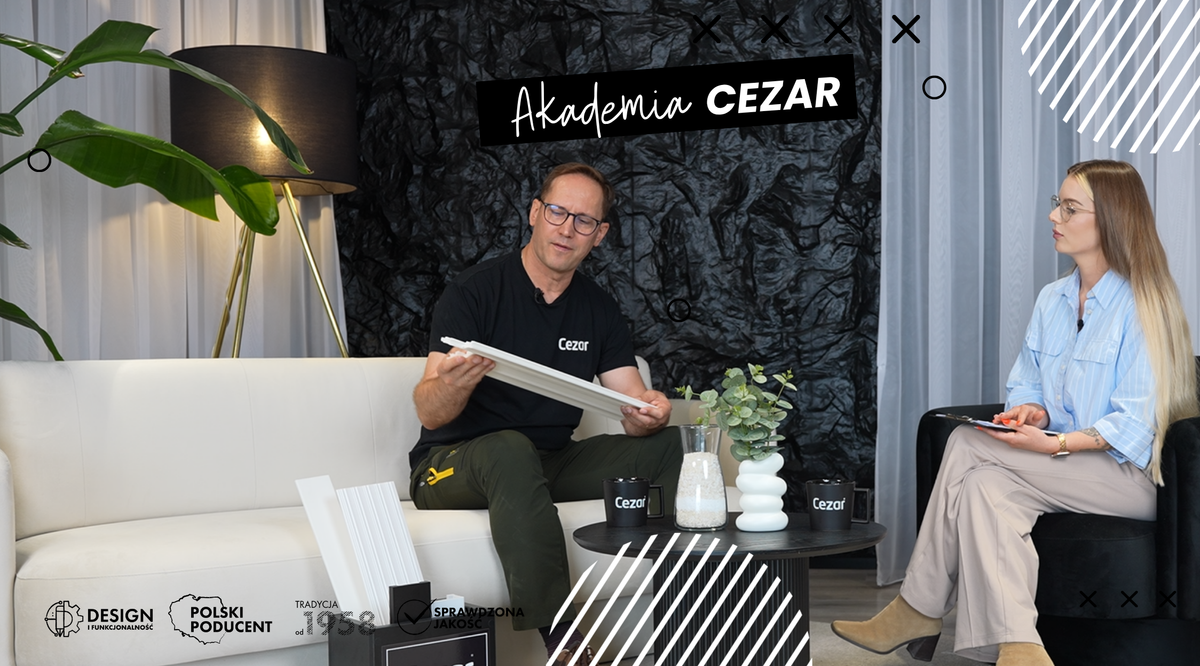
In the latest episode of the Akademia Cezar podcast, Andrzej Surynt, Production Manager, revealed the secrets behind the production of decorative profiles. In this article, you will learn about the advanced manufacturing process, why recycling is the foundation of our production, and what design solutions are setting current interior design trends.
What is HDPS and how is it produced?
HDPS is a high-density foamed polystyrene blend that achieves excellent functional properties after mixing the components at the right temperature and cooling it precisely. This material is used to create lightweight yet extremely durable finishing profiles for floors, walls, and ceilings.
The manufacturing process is based on continuous extrusion on specialized production lines. Cezar's machinery operates continuously 24 hours a day, 7 days a week, with breaks only for Christmas and Easter. This allows us to achieve a production capacity of around 6,000 finished profiles per day.
Each profile is made using a three-layer structure:
- Inner core: Made from over 70% eco-friendly regranulate from the recycling process.
- Outer coating: A layer made of special high-impact granules, providing resistance to mechanical damage and scratches.
- Surface blend: An optimized composition tailored to the specific function of the profile.
🛒 Recommended products from this category:
Check out our dedicated collection: Polystyrene skirting boards and choose the perfect solution for your interior.
Sustainability and responsible production: Over 70% recycled material
Sustainable development and environmental care are the foundation of modern plastics processing. At Cezar, a closed-loop raw material cycle is a priority. Over 70% of the raw material base used to create HDPS profiles consists of high-quality recycled regranulate.
In addition, internal quality control procedures minimize waste. Skilled line operators continuously monitor extrusion parameters, correcting any deviations. This ensures dimensional consistency and the highest aesthetic quality for every element.
Finishes tailored to your needs: Primer and satin versions
After leaving the extrusion line, HDPS profiles go to Cezar's painting stations. They are prepared in two finish variants:
- Primer version: The surface is factory-prepared for painting with water-based paints (e.g., acrylic or latex). This allows you to precisely match the skirting board to the wall color or create a contrasting accent.
- Satin finish version: An elegant, ready-to-install white skirting board with a silky texture.
Trend overview: From slim profiles to LED masking
Modern interiors require functional solutions tailored to various architectural concepts. Cezar offers specialized series of HDPS profiles:
Bold background and depth: Solid-colored black profiles
Contemporary industrial style and modern minimalism often incorporate dark accents. Our cut and finished solid-colored black skirting boards maintain color consistency throughout their cross-section, eliminating the risk of visible scratches or damage.
Discretion and cleanliness: Slim series profiles
The compact design and subtle bevel on the top edge mean that Future Slim skirting boards minimize dust accumulation, serving as an aesthetic alternative to classic panels and traditional aluminum profiles.
Three-dimensional wall texture: Thalia panels and mouldings
Wall applications go beyond traditional flat surfaces. The unique collection, which includes Thalia decorative wall panels, allows you to create a three-dimensional TV background, pillar finishes, or hidden flush-to-wall door openings. Flexible profile variants also allow for installation on arches and curved architectural features.
LED light control: Light-blocking technology
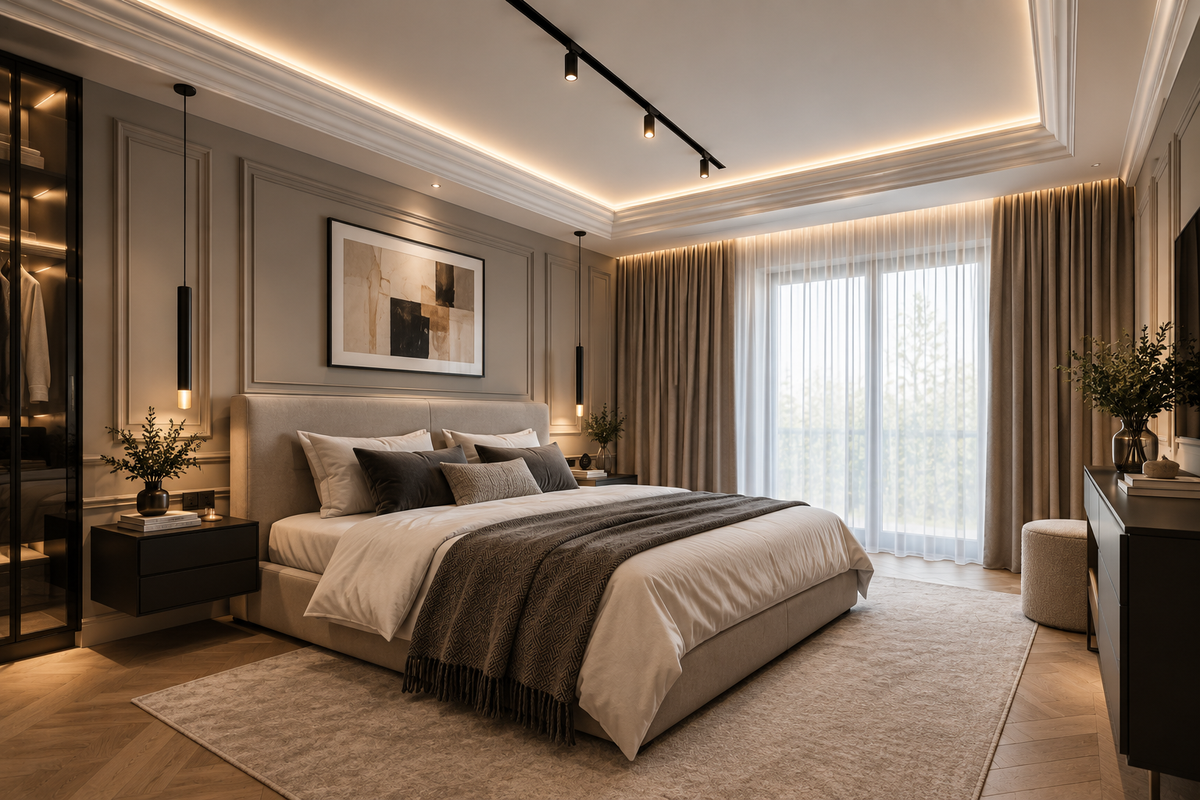
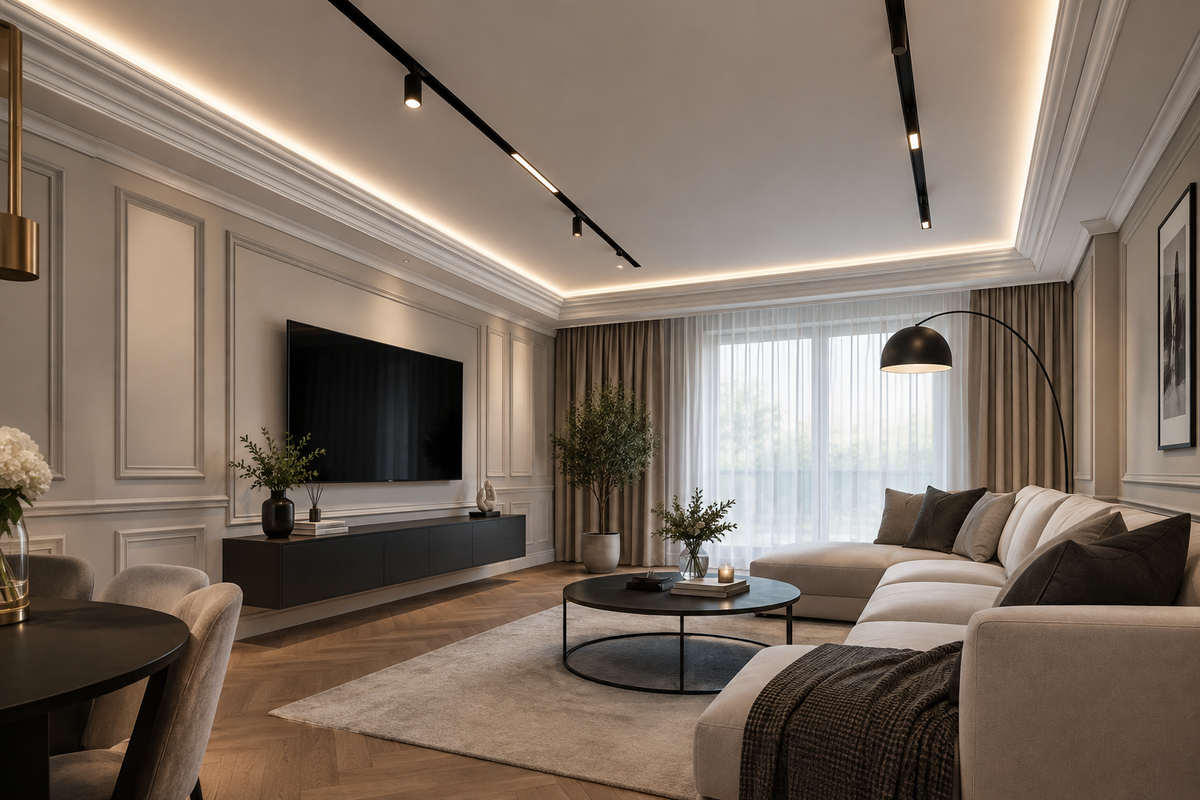
Integrating LED lighting with mouldings requires eliminating the phenomenon of light bleeding through the plastic structure. A specially developed blend with a light-blocking component (so-called light blocker) ensures that dedicated Cezar curtain and ceiling mouldings direct the light beam perfectly onto the curtain or wall, guaranteeing an elegant and professional effect.
Common mistakes when choosing and installing mouldings
- Failure to consider moisture: Using MDF boards in areas exposed to direct contact with water without proper protection (we recommend choosing waterproof HDPS or PVC).
- Choosing the wrong paint: Applying solvent-based paints directly to the profiles, which can damage the plastic structure (we recommend water-based paints).
- Installing traditional profiles with LED lighting: Using standard skirting boards without a light blocker, which causes unsightly light bleeding through the material.
- Incorrect proportions: Installing profiles that are too tall (over 10 cm) in low rooms, which visually lowers the interior.
Summary: Why choose Cezar HDPS products?
- Durability: Impact resistance thanks to the high-impact outer coating.
- Water resistance: Complete moisture resistance, ideal for kitchens, bathrooms, and hallways.
- Sustainability: Over 70% of the raw material comes from recycling.
- Modern design: A wide selection of variants — from Slim finishes, through solid-colored black profiles, to dedicated solutions for LED strips.
FAQ – Frequently Asked Questions
What are the main advantages of HDPS material compared to MDF?
HDPS is completely moisture-resistant, has higher mechanical impact resistance, and weighs less. It does not swell when exposed to water, making it an optimal choice for any type of room.
Can HDPS skirting boards be painted any color?
Yes, profiles supplied in the primer version can be painted with any water-based paint (acrylic, latex, or vinyl).
How does the curtain moulding line differ from regular profiles?
Cezar curtain and ceiling mouldings are made from a special blend containing a light blocker. It prevents LED light from bleeding through the plastic structure.
Do black HDPS skirting boards require additional painting after purchase?
Black profiles are solid-colored during the extrusion process and then finished with a lacquer coating, making them a fully ready-to-install product.
Share:
Bridging Education and Industry: Cezar Establishes an Internal Partnership with the Vocational Training Center in Ełk
Japandi style in interior design – how to choose mouldings and profiles to create a cohesive, harmonious space?