
Choosing the right floor finish is a crucial part of any interior design project. Once your dream panels or tiles are in place, it's time for the details that will tie the entire interior into a cohesive whole.
Installing skirting boards with adhesive is currently the most popular and aesthetically smoothest method of interior finishing. It avoids visible screw heads, dowels, or troublesome drilling into hard walls. Discover a professional guide that will walk you through this process step-by-step.

Tools and materials – what to prepare?
Before you start work, gather a set of tools and high-quality mounting chemicals. You will need:
A hand saw with fine teeth or a miter saw,
A miter box (cutting jig),
A caulking gun,
Measuring tape and pencil,
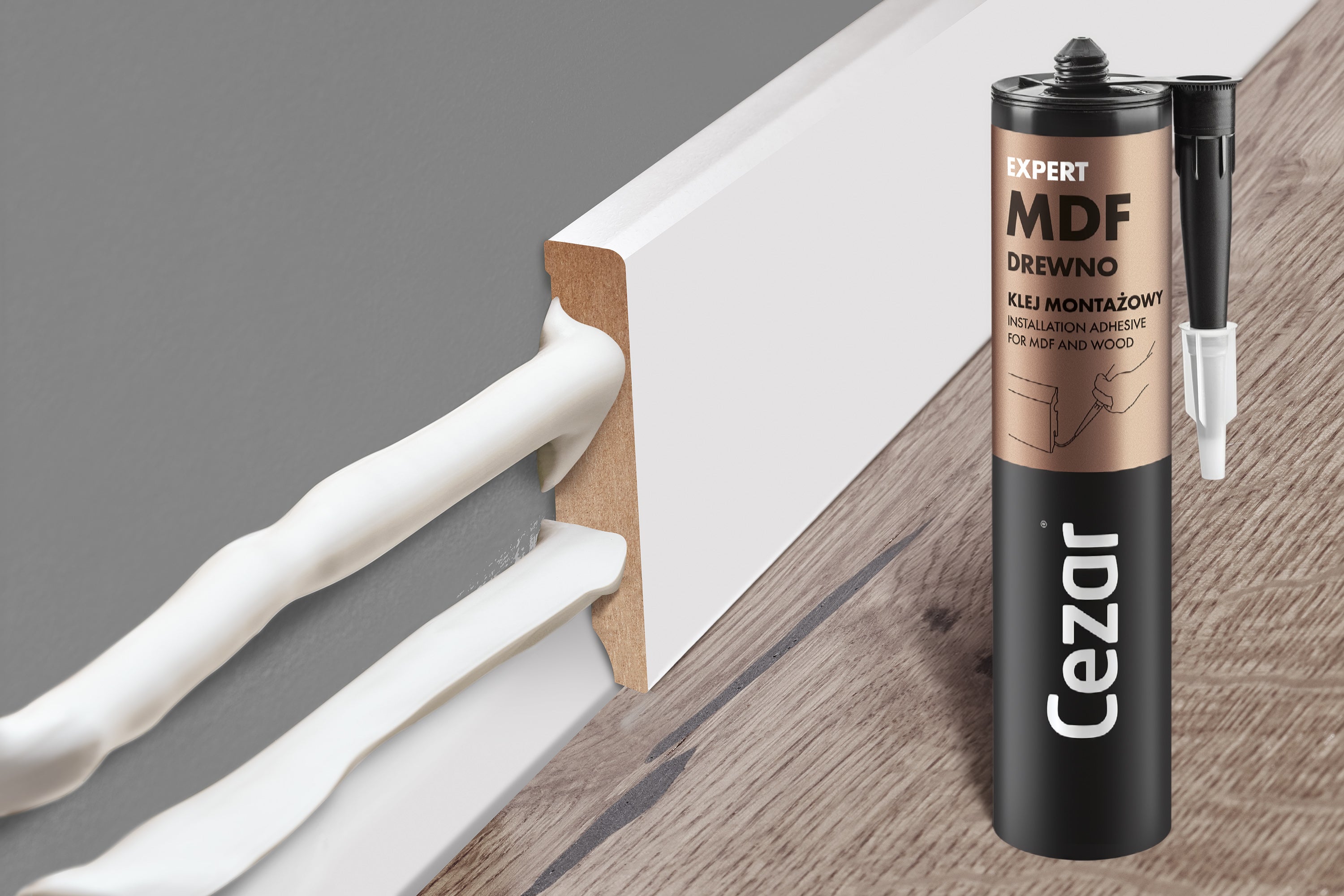
Professional mounting adhesive and dedicated joint adhesive.
Recommended products for your interior
The choice of skirting board itself depends on the specifics of the room, ceiling height, and planned style. Here are three excellent options that work well for adhesive mounting:
For tall, elegant interiors: PVC Status Line skirting board 100x15mm white matt – a high, 10-centimeter premium profile that optically elevates the room and gives it a luxurious character.
For lovers of modern gray: PVC Status Line skirting board 80x15mm cashmere grey semi-matt – universal height of 8 cm and a fashionable cashmere shade, ideal for modern, subdued arrangements.
Classic minimalism: PVC Masterline skirting board 13x80mm white matt – a slender, simple form that blends perfectly into the background, suitable for any type of flooring.
If you are looking for other material solutions or designs, check out modern PVC and MDF skirting boards, where you will find a full range of profiles tailored to every budget and technical requirement.

Adhesive skirting board installation – a step-by-step guide
According to Cezar's official technical recommendations, the installation process should be carried out in the following stages:
Step 1: Acclimatization and subfloor preparation
Before opening the packages, the skirting profiles must undergo an acclimatization process in the room where they will be installed for a minimum of 24 hours. Store them horizontally on a flat, insulated surface (e.g., on cardboard or underlay).
During this time, prepare the wall and floor surfaces. The subfloor must be dust-free, dry, and thoroughly degreased. Use a vacuum cleaner to remove any plastering or sanding residue from the walls.
Step 2: Cutting profiles and corners
Measure the wall length accurately. Cut the profiles using a saw and a miter box.
Internal and external corners: Both connecting skirting boards should be cut precisely at a 45° angle.
Edge finishing (ends): If the skirting board ends at a door frame without a dedicated post, create an aesthetic finish. Cut the end at a 45° angle and glue a small, inverted piece of profile to cover the internal structure of the skirting board.
Step 3: Applying mounting chemicals
Apply even beads of mounting adhesive to the dry and clean back of the profile.
Important manufacturer's note: Never use acetic silicones for mounting polymer and PVC skirting boards! They can damage the material structure or cause discolouration. Use only chemically neutral, dedicated mounting adhesives.
Step 4: Adhering to the wall and joining sections
Place the skirting board against the wall and press firmly along its entire length. If the wall has slight imperfections, you can temporarily press the profile with a heavy object while the adhesive sets.
When installing subsequent sections on a straight wall, apply a special joining adhesive to their joints. This will bond the edges, preventing gaps from forming in the future.
Step 5: Finishing touches
After all elements are adhered, fill any minimal gaps at the corner joints with joining adhesive. Immediately remove any excess adhesive with a damp cloth. The space between the top edge of the skirting board and the wall can be neatly filled with acrylic sealant or mounting adhesive.
Common installation errors – what to avoid?
-
Lack of material acclimatisation: Ignoring the 24-hour acclimatisation rule means that the skirting boards may slightly change their micro-dimensions after gluing, resulting in cracked joints in the corners.
-
Adhering to a dirty wall: Leaving construction dust at the bottom of the wall drastically weakens the adhesive's bonding strength. The skirting board may start to detach after a few weeks.
-
Using aggressive silicone: Using acetic silicones instead of polymer or hybrid adhesives will damage the lacquered surface of the skirting board.
-
Too thick a layer of mounting adhesive at the joints: Always use thin joining adhesive between two skirting boards, not thick mounting adhesive, which will prevent the profiles from being perfectly pushed together.

Work summary (Installation Checklist)
Before putting away your tools, make sure you have checked off all the points:
-
[ ] Profiles were left in the room for at least 24 hours before cutting.
-
[ ] The floor and wall strip were thoroughly vacuumed.
-
[ ] All corners were cut at a 45° angle.
-
[ ] Joining adhesive was used for straight joints and corners.
-
[ ] Acetic silicone was not used for installation.
FAQ – Frequently Asked Questions
How to choose the colour of skirting boards for an interior?
Design principles suggest three safe approaches: matching the exact colour of the floor (creating a calm, uniform surface), matching the wall colour (optically raising the room height), or using a universal, modern accent such as white, grey, or anthracite.
Are PVC skirting boards suitable for kitchens and bathrooms?
Yes. Unlike standard MDF skirting boards, which can swell in humid environments, modern polymer and PVC skirting boards are completely waterproof and flexible. They can be safely mopped and installed in areas exposed to splashes.
What to do if the walls in the apartment are very uneven?
For large wall curves, flexible plastic profiles (PVC) work best, as they can adapt slightly to the curvature. The skirting board should be pressed firmly, and any gaps at the top can be concealed with flexible filler or acrylic sealant.
What height of skirting boards should be chosen for a standard apartment?
For modern, minimalist interiors with a height of approx. 250-260 cm, profiles with a height of 8 cm (e.g., Status Line 80 mm or Masterline) are most often chosen. In tall townhouses or premium homes, striking 10-15 cm profiles look excellent.
Where can I find the full range of Cezar skirting profiles?
You will find a wide selection of shapes, heights and manufacturing technologies directly in the official brand store by visiting the category modern PVC and MDF skirting boards.

Share:
Skirting boards with a cable duct: how to hide cables without chasing walls
Installation Guide: Skirting boards on clips or glue? Choose the ideal system for your interior