
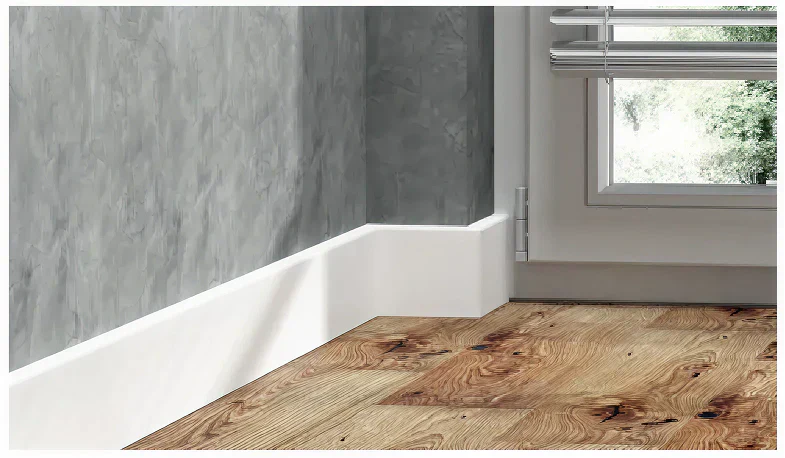
What skirting board height to choose? Size guide (60, 80, 100, 120 mm)
Choosing the right skirting board is a crucial step in interior finishing, as it determines the final proportions of a space. A well-chosen profile can visually elevate a room, hide cables, and unify the entire arrangement. Conversely, errors in size selection can overwhelm the space. Learn how to match the skirting board height to your home.
Skirting board height and interior proportions – the golden rule
In interior design, the primary rule is to match the size of details to the room's volume. The main reference point when choosing a profile should always be the ceiling height.
A too-low skirting board in a tall tenement house will visually "disappear" and give the impression of an unfinished renovation. Conversely, a very tall model in a low apartment building will drastically visually reduce the space and visually disconnect the wall from the floor.
Overview of heights: which models suit which interiors?
60 mm skirting boards – discreet minimalism
6 cm high skirting boards are a minimalist, technical solution dedicated to specific tasks.
Where they fit: Low apartments (below 2.5 m high), small children's rooms, wardrobes, and narrow hallways.
Style: Modern minimalism, industrial style, and interiors where attention should be focused solely on furniture or wall coverings.
Advantages: They are extremely discreet, unobtrusive, and allow for maximum exposure of the wall surface.

80 mm skirting boards – a universal happy medium
An 8 cm height is currently the most popular and safest choice, used in most modern designs.
Where they fit: Standard developer apartments and houses with a ceiling height of 2.5 to 2.7 meters.
Style: Scandinavian style, modern classic, loft, and eclectic interiors.
Advantages: They create a distinct, aesthetic border for the floor, perfectly mask standard expansion gaps, and do not disrupt the room's proportions.

100 mm skirting boards – elegance and a premium effect
Ten-centimeter profiles are already a distinct decorative element that catches the eye and gives the interior an exclusive character.
Where they fit: Spacious living rooms, detached houses, and apartments with a height of over 2.7 meters.
Style: Glamour style, modern classicism (modern classic), and English interiors.
Advantages: They allow for hiding thicker bundles of electrical wires and perfectly complement bold wall colors.
120 mm and higher skirting boards – palace style and tenement houses
Tall profiles (12 cm and more) are the domain of spaces with above-standard height that require strong architectural forms.
Where they fit: Classic tenement houses, lofts with high ceilings, and residences where room height exceeds 2.9–3 meters.
Style: Parisian, New York, Hamptons, and classic styles.
Advantages: They emphasize the metropolitan or palatial character of the interior. They look excellent when combined with other decorative elements, such as ornate wall stucco.

Common mistakes when choosing skirting board height
Ignoring ceiling height: Installing a 120 mm profile in a 2.4 m high room will drastically lower it visually.
Mismatch with door architrave thickness: Skirting boards should not drastically protrude beyond the door frame – the thickness and height of both these elements must harmonize.
Wrong material selection for room function: In bathrooms and kitchens, a tall MDF skirting board will quickly deteriorate due to moisture. In such places, waterproof PVC skirting boards should be used, which guarantee complete water resistance regardless of their height.
Summary – a quick shopping checklist
[ ] Measure the room height – for standard interiors (2.5–2.7 m), choose a universal height of 80 mm.
[ ] Match the profile style – simple shapes of 60–80 mm suit modern styles, while ornate 100–120 mm suit classic styles.
[ ] Verify expansion gaps and cables – if you need to hide thick cables, choose a taller model with special grooves.
[ ] Match the material to the conditions – in the living room, opt for MDF or durable hybrids, and in damp areas, for PVC.
FAQ – Frequently Asked Questions
Does a tall skirting board always make a room smaller?
No. A tall skirting board (e.g., 10–12 cm) will only visually reduce low rooms. In spaces with a height of over 2.8 meters, it is a completely natural element that maintains the wall's proportions. Moreover, if you paint a tall skirting board the exact same color as the wall, you can achieve the effect of visually raising the room.
How to choose the skirting board height for a small but tall room?
In rooms with a small floor area but a high ceiling (e.g., bathrooms or wardrobes in tenement houses), it is worth exercising moderation. An 80 mm high profile will be the best choice. It will not overwhelm the limited floor space, and at the same time, it will not disappear in the vertical perspective of a tall interior.
How to match the skirting board height to the door frame?
Visually, the safest solution is the rule that the height of the skirting board corresponds to the width of the side masking architrave around the door. As a rule, these architraves are about 70–80 mm wide, which is why 8 cm high skirting boards look most cohesive next to them. Also, remember that the skirting board should not be thicker than the door architrave to avoid unsightly offsets.
Can different skirting board heights be combined within one apartment?
Yes, this is permissible, provided you maintain the identical profile shape and color scheme. Taller skirting boards (e.g., 100 mm) are suitable for an open, representative living room combined with a dining room. In small, enclosed utility rooms, such as a pantry or an adjoining wardrobe, you can smoothly transition to a lower variant (e.g., 60 or 80 mm) from the same product series.
Where can I find a full range of profiles suitable for every type of interior?
All height variants and a wide range of materials can be found directly in the stucco and wall decorations category on the Cezar brand website. This will allow for precise matching of products in terms of technical and visual aspects to the assumptions of each project.
Share:
Step-by-step guide: How to choose threshold strips for your interior?
Children's joy and dance energy – we support the Ełk Dance Review!