
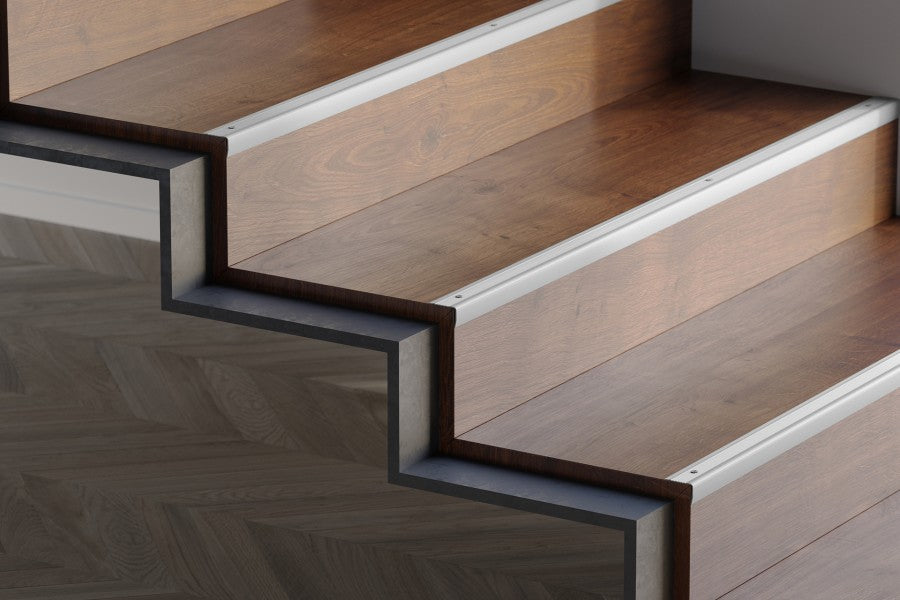
Finishing stair edges requires combining high aesthetic standards with resistance to heavy use. The edges of steps are particularly vulnerable to mechanical damage, wear and tear, and chipping of the finishing material. Properly selected profiles protect the covering, conceal expansion gaps and, above all, provide residents and building users with a stable and safe footing.

Why use stair profiles?
Corridors and stairwells are high-traffic areas. Without proper protection, even the highest-quality ceramic, wood or panels are susceptible to gradual deterioration along the edges.
-
Mechanical protection: Edge guards protect flooring material from cracking and chipping.
-
Safe use: Ridges, ribbed textures or anti-slip inserts help prevent slips.
-
Concealing expansion joints and cut edges: They cover uneven edges of floor coverings and installation gaps, creating a neat line.
-
Quick renovation: Installing angle profiles makes it possible to neatly cover old, worn step edges without replacing them.
How to choose a profile for the type of floor covering and the specific stairs?
The right solution depends directly on the flooring material, the thickness of the covering and the shape of the steps.
1. Purpose-designed solutions for vinyl flooring (LVT)
Due to their low thickness, vinyl panels require a finish with highly precise geometry. To protect an LVT edge effectively without creating unnecessary raised edges, specialist profiles for LVT flooring.
An example of a proven engineering solution is the aluminium profile for LVT flooring (e.g. type Z3LVT for coverings with a thickness of $3\text{ mm}$). It holds the panel firmly in place while providing durable protection for the step edge itself.
2. Ribbed edges for areas with an increased risk of slipping
In high-traffic areas or on home staircases used by children and older people, an anti-slip surface is essential. In these cases, aluminium ribbed stair profileswith longitudinal ridges that improve footwear grip are ideal.
3. Bridging level differences and accommodating non-standard slopes
For steps with unusual geometry or where surfaces at different heights meet, tailored profiles for sloped transitionswork well. They smoothly conceal level differences and help prevent trips.
4. Finishing flush joints on landings
At the top edges of staircases and where they meet a flat corridor or landing, discreet flat transition profilesare ideal. They stabilise the edge of the material while maintaining a minimalist look.
Installing stair profiles – what to keep in mind?
The strength of the joint depends on choosing the right installation method. Depending on the model and substrate, the following methods are used:
-
Installation beneath the tiles: The profile is embedded in ceramic tile adhesive as the tile is laid.
-
Press-fit pin / dowel installation: Provides a secure, long-lasting hold in concrete or screed substrates.
-
Installation with hybrid adhesive or tape: Quick, drill-free installation on finished steps.
Technical note: When cutting metal profiles, do not use tools that cause the material to overheat (e.g. angle grinders without cooling), as this can damage the anodized coating. For installing metal components, only chemically neutral adhesives and silicones are recommended.
Common finishing mistakes
-
Incorrect thickness match: Using profiles whose profile depth does not match the thickness of the panels or tiles.
-
Using harsh chemicals: Cleaning aluminum profiles with products containing chlorine or solvents.
-
Leaving residue behind: Leaving wet mortar and grout on anodized components without immediately rinsing them off with clean water.
-
No expansion gap: Bonding profiles without leaving the minimum clearance required for materials that expand and contract (e.g. wood or LVT).

Summary: Safe steps checklist
-
[ ] Measure the exact thickness of the floor covering (3, 5 mm}, ceramic, etc.).
-
[ ] Choose an installation option (under-tile, surface-mounted, screw-fixed, or adhesive-mounted).
-
[ ] In high-traffic areas, choose profiles with a ribbed surface.
-
[ ] Use chemically neutral installation adhesives and promptly remove mortar residue from aluminum surfaces.
Frequently asked questions (FAQ)
1. Can a stair profile be installed after laying panels or tiles?
Yes. For finished steps, surface-mounted angle profiles are used, installed with hybrid adhesive, double-sided tape, or wall plugs.
2. How do you choose a profile for thin LVT vinyl panels?
Choose a model with a low-profile edge designed for the specific panel thickness, using products from the LVT panel profiles.
3. What is the difference between a ribbed and a smooth profile?
A ribbed profile has longitudinal grooves on its surface that provide anti-slip properties and improve the foot's grip on the edge of the step.
4. How should aluminum stair profiles be cleaned?
A soft cloth with clean water or a mild detergent is sufficient for cleaning aluminum surfaces. Avoid chlorine-based products and corrosive cleaners.
5. Where can I find a complete range of stair edge protection?
A wide selection of dedicated finishing solutions to suit every type of flooring is available directly in the stair profiles.



Share:
Glazed and terracotta trim profiles – how to effectively protect tile edges? Step-by-step guide
Which ceiling track should you choose and what to check before buying? A step-by-step guide