
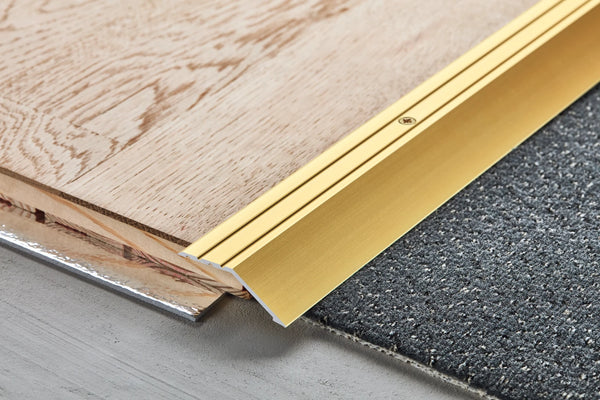
The aesthetic and durable connection of two different flooring materials is one of the biggest challenges when finishing an interior. Threshold strips not only mask the technical expansion joint but, most importantly, protect the edges of the floors from mechanical damage and facilitate daily cleaning. The choice of the appropriate solution primarily depends on the geometry of the flooring joint.
Below, we present a detailed overview of profiles, based on a professional structural division.
1. Joint profiles
Joint profiles (also known as expansion profiles or T-profiles) are minimalist solutions dedicated to connections where both floorings meet at an ideally even level. They are characterized by a flat or very subtly rounded shape.
Application: Connecting laminate, vinyl, or wooden panels with ceramic tiles in places where installers have perfectly matched the screed height and cladding thickness.
Characteristics: Their construction (often T-shaped) allows the vertical foot to be inserted deep into the expansion joint, thus perfectly masking the edges and stabilizing the flooring, remaining almost imperceptible underfoot.
Example product: An excellent representative of this group is the minimalist smooth aluminium joint profile 14mm.

2. Oval threshold profiles
Oval profiles have a delicate, arched rounding on the top side. This is the most versatile group of strips, which works well with both horizontal connections and small differences in flooring height (usually up to a few millimeters).
Application: Transitions between rooms with similar floor heights, where material movement or minimal installation errors have created a slight step.
Characteristics: Thanks to their unique geometry, oval profiles press down on the edges of both floors, optically leveling slight differences in height. Multifunctional systems in this category allow for flexible installation depending on the technical conditions in your home.
Example product: A choice guaranteeing full flexibility is the aluminium threshold strip 37mm 5-in-1.

3. Flat threshold profiles
The main distinguishing feature of this category is its maximally lowered construction and wide covering area. They work well wherever the expansion joint is exceptionally wide or the edges of the flooring require strong pressure and additional protection.
Application: Wide expansion joints, connecting floors with significant movement, or areas where tile edges have chipped during cutting.
Characteristics: The wide profile guarantees a safe covering margin on both sides. Selected models are enhanced with special technical elements that increase user comfort, such as integrated rubber inserts that effectively dampen vibrations and seal the threshold.
Example products: In this group, you will find solutions such as the flat aluminium wide threshold strip 45mm with rubber or the more classic flat aluminium threshold strip 35mm 5-in-1.

4. Sloping profiles
Sloping profiles (often called transition or ramp profiles) are products for special tasks. Their asymmetrical design is intended for the safe and smooth connection of floorings with distinctly different levels.
Application: Connecting thick parquet with thin carpeting or terracotta, as well as transitions to utility rooms where there is a distinct threshold.
Characteristics: The sloping profile smoothly tapers towards the lower floor, creating a safe "ramp". This prevents painful tripping, protects the delicate edges of the higher flooring, and allows for smooth passage of, for example, robotic vacuum cleaners.
Example product: The aluminium sloping threshold strip 46x16mm is designed to eliminate distinct steps.

Common mistakes in choosing the type of strip
Installing a flat T-bar on steps: Attempting to forcefully press a joint profile onto floors of different heights results in deformation of the aluminum and rapid detachment of the strip.
-
Profile too narrow for a wide gap: Not leaving an adequate allowance causes the working floor to slide out from under the trim, exposing an unsightly expansion gap.
-
Mounting method not matching the installation: Drilling holes for dowels in places where underfloor heating is installed in the screed, which can lead to costly failure of the heating system.
Summary of profile characteristics – checklist
-
Expansion joint profile: Choose when floors meet perfectly flush.
-
Oven-shaped profile: Use for standard transitions and minor height differences.
-
Flat profile: Ideal for wide expansion joints and when strong sealing is needed.
-
Sloping profile: Essential for visible, distinct steps and thresholds between rooms.
FAQ
Which type of profile is best for connecting panels with tiles in a living room with a kitchenette?
If both floorings are at the same level, a minimalist expansion joint profile will be the best choice. If there is a minimal step, opt for an oven-shaped profile, which will smoothly conceal the slight height difference.
Does installing a sloping profile require drilling into the floor?
It depends on the chosen variant. Models are available for mounting with hidden dowels (requiring drilling) and versions mounted with special, flexible and chemically neutral mounting adhesives, which is recommended for underfloor heating.
What is the difference between laminated and anodized profiles?
Anodized profiles undergo an electrochemical process that hardens the aluminum and gives it an elegant, metallic finish (e.g., gold or silver matte). Laminated profiles are covered with a special veneer with a high abrasion class (e.g., AC4), which perfectly reproduces the structure and color of natural wood.
Where can I find a complete overview of the described finishing solutions?
All the technical variants mentioned and a rich color palette are included in the entire category of Cezar threshold profiles, facilitating precise product selection for every type of flooring.



Share:
How to properly install a threshold strip? A DIY guide
PVC, MDF, polystyrene or aluminum strips? A great comparison of materials