
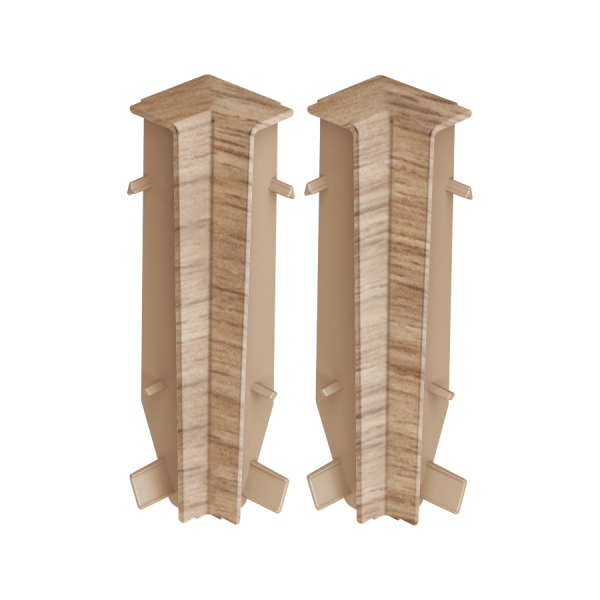
A perfectly finished floor is not just a matter of attractive panels or ceramic tiles, but also of carefully considered details. The element that brings the entire design together is the skirting boards. To ensure they can be installed efficiently and that the joints at corners and along long walls look neat, it is essential to use dedicated accessories.
Internal corners, external corners, connectors, and left- and right-hand end caps eliminate the need to make complicated 45-degree cuts in the profiles. How should you use them correctly to achieve a durable, attractive finish?

The role of finishing accessories in skirting board installation
Finishing accessories for skirting boards serve two key purposes: aesthetic and protective. They conceal cut edges and expansion gaps at the walls, and ensure visual continuity along the skirting.
Each component in the system has a specific purpose:
-
Internal corners – used at inward-facing corners (where two walls meet inside a room).
-
External corners – used at outward-facing corners (e.g. around columns, window recesses or partition walls).
-
Connectors (straight connectors) – used to neatly join two lengths of skirting along a long, straight wall.
-
End caps (left and right ends) – cover the exposed ends of the skirting where the profile terminates without meeting a wall (e.g. at door frames).
By using dedicated accessories matched to a particular collection, you can be sure that their shade, height and finish will perfectly match the main profile.

How to use corners, connectors and end caps correctly
Installing finishing accessories is straightforward, but certain technical guidelines must be followed to prevent unsightly gaps.
1. Internal and external corners
Before installing the skirting, cut the profile at a right angle (90 degrees). Fit the corner piece directly over the edge of the skirting. For two-part systems, first attach the base to the wall, then fit the decorative element together with the corner piece.
Tip: Make sure the angle where the walls meet is close to 90 degrees. If it deviates more significantly, flexible PVC accessories can accommodate minor wall irregularities without the material cracking.
2. Straight connectors
Skirting boards are typically 200 to 250 cm long. Where a wall is longer than this, two lengths need to be joined. Fit the connector between two profiles cut at right angles. This prevents visible gaps caused by the material expanding or contracting with temperature changes.
3. End caps
Areas around door frames require the profile to be neatly finished. End caps are always supplied in pairs (left and right). Fit them into the open end of the skirting profile. If necessary, you can secure them from the inside with a dab of assembly adhesive to prevent them from coming loose during use.
A practical guide to installing accessories on the Hi-Line Prestige skirting board
The best way to understand how to use corners and connectors correctly is to look at a specific model. A great example of a modern design is the Hi-Line Prestige PVC skirting board. This profile features a uniform design and integrated elastomers that seal the joints against the wall and floor.
Step-by-step installation instructions:
-
Preparing the work area and cutting: Start by positioning the profiles securely. A Cezar wooden trestle provides a convenient work surface on which you can safely hold the skirting in place and cut it at a right angle using a hand saw.
-
Attaching the skirting base to the wall: You can install the Hi-Line Prestige skirting board using wall plugs as usual, or use the dedicated PE mounting clip. For hard-to-reach areas, Expert white assembly adhesive is indispensable, providing strong initial grab.
-
Fitting corners and connectors: Once the cut profile is secured, fit the appropriate accessory onto its end – an internal corner, external corner or straight connector. The accessories in the Hi-Line Prestige range are designed to snap into place, so you simply press them onto the edge of the skirting without using specialist tools.
-
Finishing around doors: Fit the dedicated left- or right-hand end caps onto the ends of profiles that meet door frames, making sure they are firmly pressed against the edge.
How to choose accessories for your skirting board material
The right accessories depend on the technology and material used to make the skirting boards:
-
PVC skirting boards (e.g. Hi-Line Prestige, Cezar 60): These have dedicated accessory systems made of flexible plastic that are fitted by pressing them into place. They are 100% waterproof and ideal for rooms exposed to moisture.
-
MDF and polystyrene skirting boards: For premium MDF or polystyrene profiles, use dedicated integrated corner pieces or make conventional angled cuts with a mitre box and adhesive.
When choosing solutions for your entire home, it is worth opting for reliable skirting boards for panels and tiles, which come with a complete system of colour-matched corner pieces and end caps.
Common mistakes when installing accessories
Avoid the following mistakes to ensure a durable, attractive finish:
-
Cutting skirting boards by eye: An unevenly cut edge may slip out of a corner piece or connector.
-
Mixing up end cap sides: The left and right end caps are mirror images of each other – swapping them will prevent correct installation.
-
Installing on dirty surfaces: Dust and debris from renovation work reduce the adhesion of components attached with glue.
-
Failing to allow for expansion: Pressing the skirting too tightly into connectors without allowing for the minimum required clearance can cause it to warp when temperatures change.
Summary – installation checklist
Before starting the finishing work, make sure you have everything you need:
-
[ ] The required number of internal and external corners.
-
[ ] Extra straight connectors for long walls.
-
[ ] Pairs of left- and right-hand end caps for doorways.
-
[ ] The right installation materials for skirting boards (adhesive or wall plugs).
-
[ ] A sharp tool for cutting profiles at right angles.
FAQ – Frequently asked questions
Are corners and end caps necessary when installing PVC skirting boards?
Yes. PVC profiles have a hollow, chambered construction, so cutting them at an angle without dedicated corner pieces would expose the internal structural ribs and look unsightly.
How do you install a corner piece if the walls do not meet at 90 degrees?
System corner pieces made of plastic have a small amount of built-in play, allowing them to conceal deviations of a few degrees without having to adjust the shape of the skirting.
What should I use to glue back a loose corner piece or end cap?
For securely fixing small accessories, fast-drying assembly adhesives for skirting boards are the best choice. Apply a small amount inside the component.
Can I buy finishing accessories on their own without purchasing new skirting boards?
Yes, finishing components are available as separate products, making them easy to replace if they are mechanically damaged.
Where can I find a full range of dedicated finishing accessories and profiles?
A wide range of coordinated finishing systems, profiles and accessories is available with professional skirting boards for panels and tiles, for an attractive, quick finish for any floor.

Share:
Painting HDPS polystyrene panels – what to pay attention to in order to achieve a perfect matte or glossy finish?
Glazed and terracotta trim profiles – how to effectively protect tile edges? Step-by-step guide